
Lebanon’s War Is Becoming a Crisis of Sovereignty
What began as spillover from a wider regional war has hardened into a contest over who will shape the border order in southern Lebanon: Israel through military facts on the ground, Hezbollah through armed resistance, or the Lebanese state through diplomacy it does not fully control.
Assessment
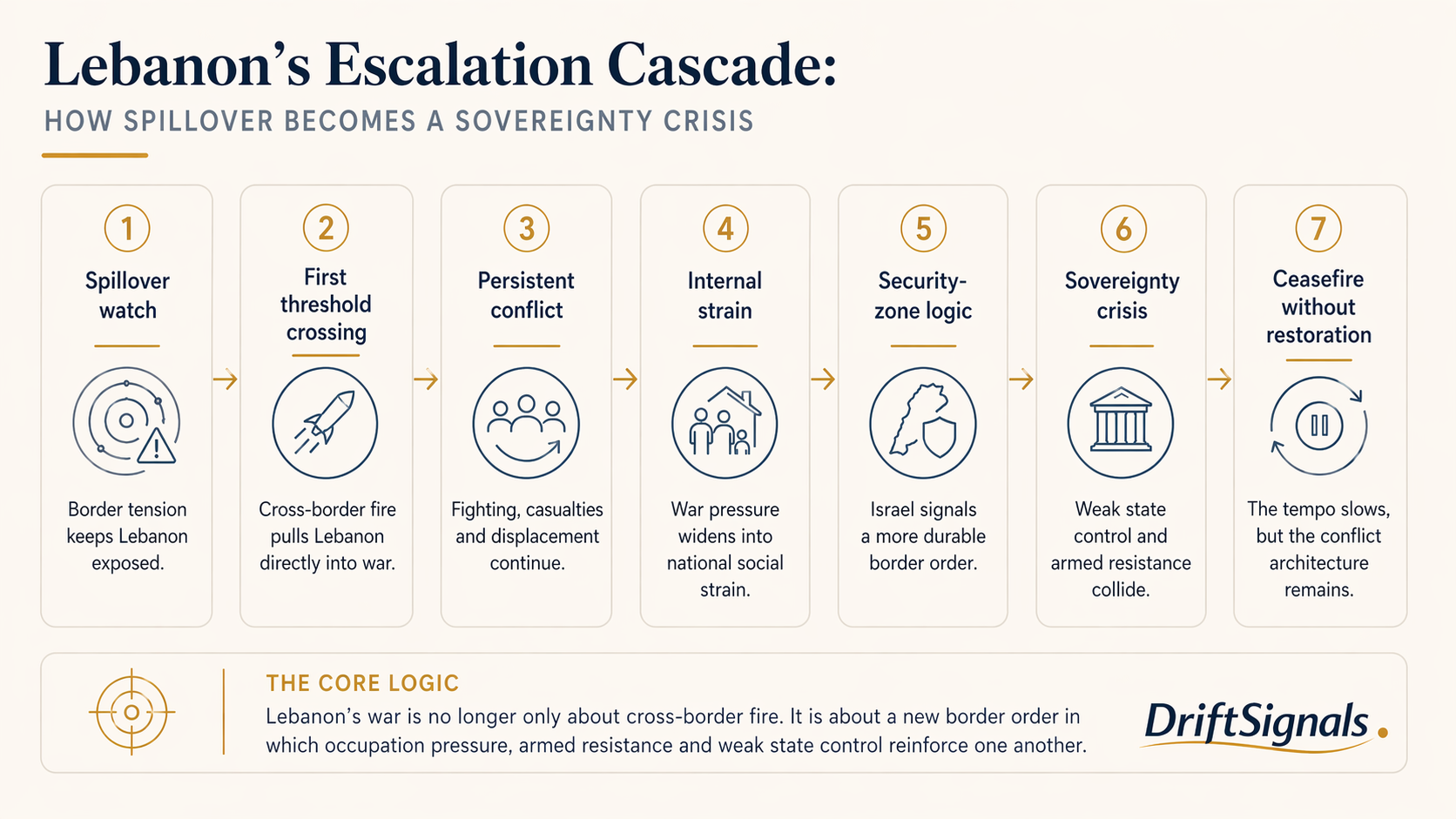
Lebanon’s March-April sequence is best understood not as a temporary side effect of a wider regional war, but as the emergence of a sovereignty crisis inside an active conflict theater. The decisive shift was not merely that violence crossed the border. It was that the conflict quickly turned into a struggle over three questions at once: who controls escalation, who controls territory in the south, and who speaks for Lebanon in negotiations over what comes next. That is why Lebanon no longer reads as a peripheral front. It now has its own escalatory logic, its own domestic strain and its own postwar stakes.
From Spillover to a Distinct Theater
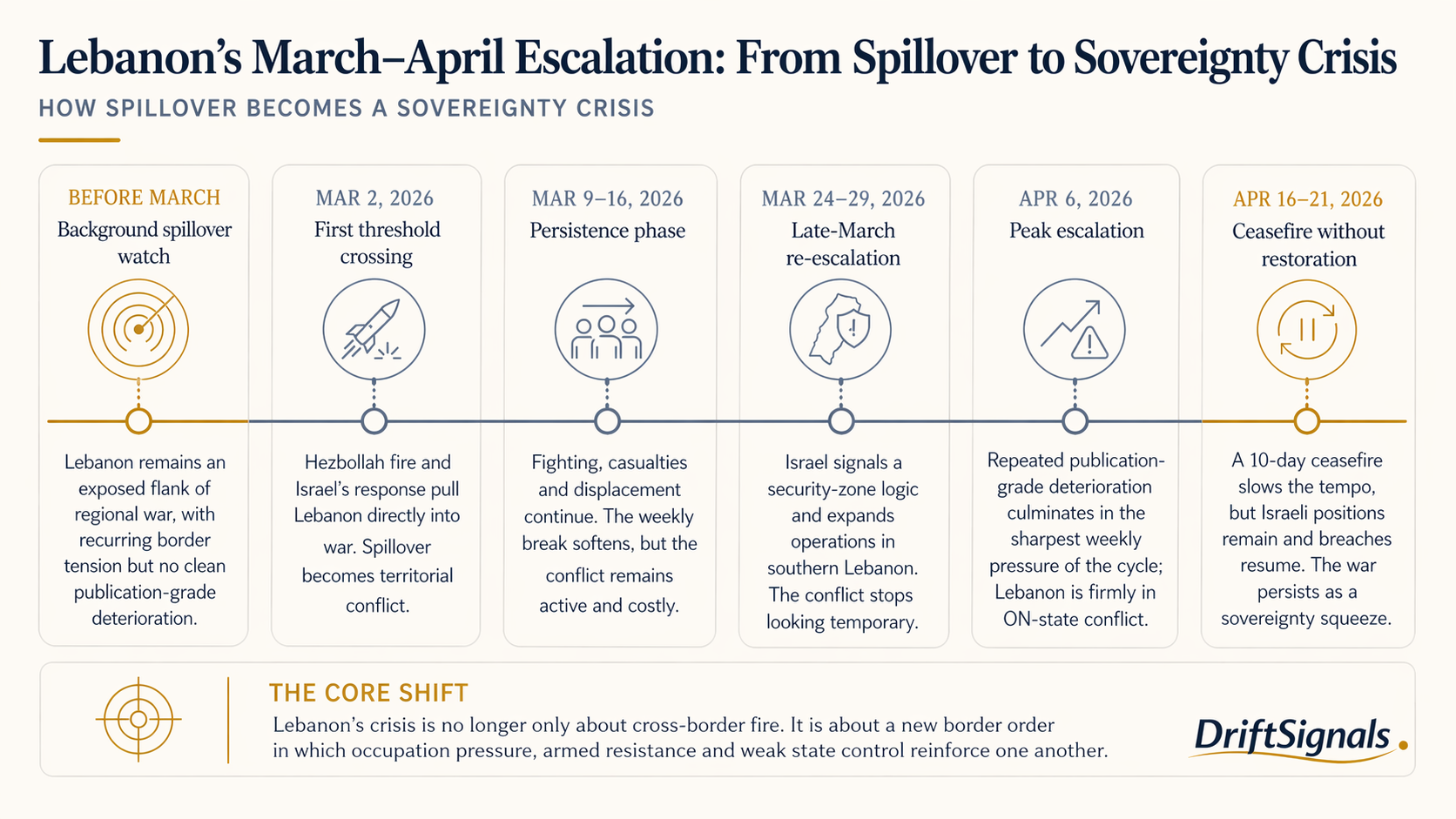
The first break came in early March. Hezbollah launched missiles into Israel, and Israel responded with troop movements into southern Lebanon and waves of airstrikes. That sequence matters because it marked the point at which cross-border pressure stopped looking like ambient regional contagion and became direct territorial conflict on Lebanese soil. In strategic terms, spillover had crossed into theater formation.
Within days, the scale of the conflict was already large enough to change the analytic frame. By March 9, nearly 700,000 people had been displaced in Lebanon in the war’s first week. At that point, the issue was no longer only whether Lebanon was exposed to the regional conflict. It was whether the country could absorb a war that was already generating mass displacement, urban strikes and national-level political strain. A border flare-up can remain geographically narrow. This did not.
The War Quickly Became a Test of the Lebanese State
The strategic significance of the war lies not only in the military line in the south, but in the pressure it has placed on the Lebanese state itself. By late March, the country was already under mounting internal strain, with displacement from mostly Shi’ite areas into Christian, Druze and mixed communities aggravating sectarian and political fault lines. That matters because it means the conflict is not just testing deterrence on the border. It is also testing whether Lebanon can manage another round of internal fragmentation without further weakening already limited central authority.
This is the deeper shift. Lebanon’s problem is no longer merely that war has spread onto its territory. It is that the war is colliding with a state that does not have a monopoly over the instruments of force in the very arena where sovereignty is now being contested. That makes each military development simultaneously a security event, a domestic political event and a diplomatic liability.
Late March Changed the Meaning of the Conflict
The most consequential escalation came when Israel publicly defined its aims in territorial terms. On March 24, Israeli Defence Minister Israel Katz said Israel would occupy a swathe of southern Lebanon up to the Litani River as a security zone, while bridges were destroyed and structures near the border were being demolished. That was the moment the war ceased to look like a severe but temporary exchange of fire and began to look like an attempt to impose a new security geography inside Lebanon itself.
That distinction is critical. A punitive campaign seeks to restore deterrence. A buffer-zone project seeks to reshape the border order. Once the conflict is framed in those terms, the political consequences change. Israel acquires an incentive to consolidate control over territory it presents as necessary for security. Hezbollah acquires a stronger justification for continued armed resistance. And the Lebanese state is left trying to defend sovereignty in an area where it does not fully control either the war or the response to it.
Humanitarian Pressure Reinforced the Strategic Shift
As the military logic hardened, the humanitarian burden widened. More than one million people had already been displaced by late March. The U.N. humanitarian update of April 16 said that since March 2, at least 2,196 people had been killed and 7,185 injured. Those figures matter not only as a measure of suffering, but as an indicator of how quickly the conflict was overwhelming Lebanon’s already limited capacity to absorb shock. Once violence on the border is producing mass displacement, infrastructure damage and pressure for high-level diplomacy, Lebanon is no longer functioning as a secondary arena in any meaningful sense.
The Ceasefire Paused the War, but Did Not Restore the Old Order
The 10-day ceasefire announced on April 16 did not restore the prewar status quo. It began alongside direct talks in Washington, but the central territorial question remained unresolved: Israel did not withdraw from the areas it had seized, and large parts of the south remained heavily damaged while residents were warned to stay out of the occupied strip. That is not a settlement. It is a pause layered over an unresolved military geography.
The point became clearer as soon as the truce was in effect. By April 20, Israel had entrenched its hold on a 5-to-10-kilometer strip inside southern Lebanon and warned residents to stay out, while talks were set to continue under U.S. auspices. On April 21, Hezbollah fired rockets and drones into northern Israel, citing ceasefire breaches, while Lebanese Speaker Nabih Berri warned that continued Israeli presence would provoke resistance. In other words, the ceasefire slowed the tempo of violence but left intact the very conditions most likely to reproduce it.
Lebanon Is Now Caught Between Occupation and Autonomous Resistance
That is what makes the current phase more strategically important than the initial outbreak. Lebanon is being pushed toward diplomacy while still lacking full control over the military reality in the south. Prime Minister Nawaf Salam said on April 21 that the Lebanese state was not seeking confrontation with Hezbollah but would not be intimidated as it pursued diplomacy and tried to protect sovereignty. That is a careful formulation, but it also reflects Lebanon’s dilemma: Beirut is being asked to negotiate over sovereignty while squeezed between Israel’s military facts on the ground and Hezbollah’s continuing claim to armed resistance.
This is the core analytical point. The central risk for Lebanon is no longer just renewed fighting. It is the possibility that a new border order takes shape before the Lebanese state can reassert authority: Israel normalizes a de facto buffer zone, Hezbollah normalizes resistance as permanent necessity, and Beirut is left trying to negotiate sovereignty from a structurally weak position. That would not be a temporary wartime distortion. It would be a redefinition of the political and security order in the south.
What Comes Next
The most likely near-term trajectory is not clean de-escalation. It is a cycle of pauses, breaches, diplomacy and renewed pressure. The key indicators are straightforward: whether Israeli forces remain entrenched inside southern Lebanon, whether talks produce anything more durable than a tactical truce, whether Hezbollah treats continued Israeli presence as an open-ended resistance trigger, and whether the Lebanese state can convert diplomacy into restored authority on the ground. So far, the external record points to fragility rather than resolution.
The deeper implication is that Lebanon did not merely absorb another war’s spillover. It became the site of a more consequential contest: not just over fire and deterrence, but over who will define sovereignty on the border once the heaviest fighting slows. That is why this war now matters in its own right. It is no longer simply a secondary front. It is a crisis over whether the Lebanese state can reclaim authority in a space where both Israeli military posture and Hezbollah’s armed autonomy continue to deny it.